
Baldwin City Directory Collections
The strongest verified starting shelf is the University of Pittsburgh Library System’s Historic Pittsburgh City Directories collection. It describes online directories published by J. F. Diffenbacher, R. L. Polk & Company, and others, chiefly for Pittsburgh and Allegheny City with some nearby-borough coverage. That is valuable regional evidence, but it is not a promise that every volume lists a Baldwin household. Open the item catalog, inspect its stated locality, and retain the precise volume and page used for a finding.
| Collection | Years | Where Held | Access |
|---|---|---|---|
| Historic Pittsburgh City Directories | Description: 1815–1945; visible filter: 1814–1963 | University of Pittsburgh Library System | Online, individual catalog records control |
| Diffenbacher Pittsburgh and Allegheny directories | 1858/59, 1873/74, 1883/84, 1889/90, and 1897/98 verified examples | Historic Pittsburgh | Digitized regional books |
| Polk Pittsburgh directories | 1918, 1923, 1924, and 1926 verified examples | Historic Pittsburgh | Digital catalog and viewer |
| Carnegie Main PA Division and microfilm room | Federal census microfilm 1790–1920 and regional aids | Carnegie Library of Pittsburgh Main | In person, staff consultation |
The collection description and its visible date filter do not match exactly. That catalog quirk is a reason to inspect the actual book, not a reason to treat the longer filter as proof of coverage. For later books, reverse-directory, telephone-book, obituary-card, newspaper-microfilm, and yearbook holdings at the local library were not verified in this research run, so call before relying on any shelf list.
Note: A book can document a name or address only after its volume, page, locality, and date have been checked.
Baldwin Township Before 1952
Baldwin Borough incorporated on January 1, 1952 from part of Baldwin Township. The former township covered land now associated with Baldwin, Whitehall, Brentwood, Castle Shannon, present Baldwin Township, and portions of Pittsburgh known by former borough names including Hays, Carrick, and Overbrook. A pre-1952 city directory result may therefore use a correct historical place name while falling outside the present borough. Search both Baldwin Township and the historic street or lot clue before deciding what a result represents.
Baldwin Borough’s history page supplies an 1878 pre-division map and the incorporation context. Its account makes place-name checking part of the search, rather than an afterthought. The borough page says the township incorporated in 1843, while a school-district history says 1844. Preserve that one-year disagreement in notes instead of silently choosing one date.
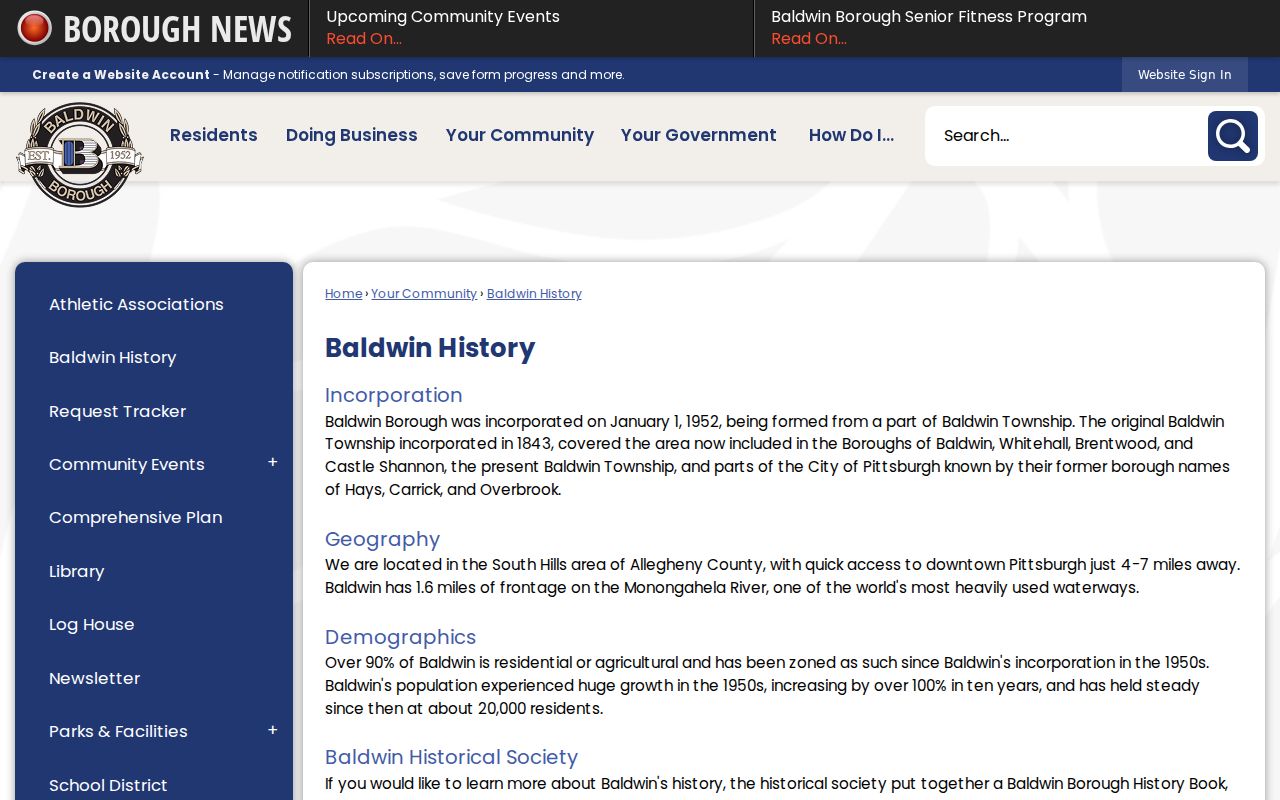
The borough history image is a useful reminder that historic geography comes before a modern boundary conclusion. It does not confirm a particular directory entry or household.
Polk and Diffenbacher Directory Years
Historic Pittsburgh provides concrete directory anchors. Its catalog includes J. F. Diffenbacher’s Directory of Pittsburgh and Allegheny Cities for 1883/84, 1889/90, and 1897/98, plus Directory of Pittsburgh & Vicinity for 1858/59. It also lists R. L. Polk & Co. Pittsburgh city directories for 1918, 1923, 1924, and 1926. These are useful dates for a Baldwin city directory search, but the titles are regional. The individual book must still be checked for an address, locality, or Baldwin Township treatment.
The verified 1926 Polk catalog item is a five-volume Pittsburgh publication deposited by Pittsburgh History & Landmarks Foundation. It gives a reliable publisher, year, and catalog route without establishing a Baldwin entry. Polk’s Homestead books for 1931–32 and 1937–38 may help with south-county context, yet their presence in the collection does not establish borough-wide coverage.
The catalog image identifies a real volume to inspect. It should be paired with the displayed item details and a page-level result before any name or address is reported.
Baldwin City Directory Entry Limits
The catalog evidence supports only a narrow inventory: the digitized collections describe listings of personal names, business names, and addresses. The scanned interior pages and publisher abbreviation keys were not reliably inspected for this research. Do not assume that a specific entry includes a spouse, occupation, owner mark, residence marker, or other familiar notation. Those details require inspection of the selected volume and its key, ideally with a librarian’s help when the viewer is unclear.
| Personal name | Collection descriptions identify personal-name listings; spellings should be recorded exactly as printed. |
|---|---|
| Business name | Collection descriptions identify business-name listings; this is not proof of a person’s home address. |
| Address | Collection descriptions identify address listings; compare the printed address with a period map. |
| Locality | Use the volume’s catalog and printed geography before assigning a result to present Baldwin Borough. |
| Entry notation | Spouse, occupation, and ownership abbreviations were not verified and should not be inferred. |
- Criss-cross directory
- An address-ordered directory format. No confirmed Baldwin-area criss-cross run was located, so it remains a question for the holding library.
- Householder index
- An index arranged around household heads in some publications. Its presence and scope must be checked in the particular volume.
- Abbreviation key
- A publisher’s explanation of its own short forms. Photograph or transcribe the key only after confirming it is printed in the chosen book.
Hopkins Maps Test Directory Addresses
After finding a possible address, use Historic Pittsburgh’s G. M. Hopkins maps to test the street and lot in the same era. The collection identifies 1896 and 1905 southern-vicinity plat books, 1916 material covering Baldwin and nearby South Hills communities, and a 1934 Volume 9 revised in 1940. Its plates can show lot and block dimensions, streets, property-owner labels, churches, cemeteries, schools, roads, and railroads.
Try the 1905 plate, the 1916 plate, or the 1934–40 volume only after the directory year and locality are known. A historical owner label is dated map evidence, not a complete title conclusion and not proof of who lived at an address. The county’s land-record route can then connect a verified lot or block to deeds, plans, historic plats, and property-history cards.
The Historic Pittsburgh directory collection and the Hopkins map collection work as a pair: one may provide a printed address, while the other checks the place-name and street setting. Keep both citations with the date.
The collection image shows the digital access route, not evidence that a particular Baldwin page is present in every listed book.
Trace Baldwin City Directories Carefully
Use a city directory as one dated observation, then build a short trail around it. The safest method pairs directory evidence with a map, a census period, and property or estate records. This avoids turning a familiar name or a modern municipal label into an unsupported family conclusion. The Baldwin resident lookup route is better suited to confirming a current record, while the historical book remains the starting point for the older address trail.
- Search one confirmed volume for the surname and spelling variants, and save the year, title, page, printed locality, and address exactly as found.
- Check the same-period Hopkins plate for the street, lot, and historical municipality before mapping the result to present Baldwin.
- Compare an earlier or later identified directory with the appropriate federal census period, keeping each record’s date separate.
- Use the parcel, deed, or estate trail when an address or relationship needs independent support.
- Record a disappearance as an open question until another dated record supports a move, death, or listing change.
Federal census access is a periodic household snapshot, not a continuous address index. Carnegie Main’s PA Division and microfilm room provide federal census microfilm through 1920 under county genealogy guidance. The same guidance names Allegheny birth and death aids for 1870–1905 and the Estates Index for 1788–1971, each a separate route when a directory gap needs context.
Libraries Behind Baldwin Directories
Baldwin Borough Library is the practical first local contact. It is at 5230 Wolfe Drive, Pittsburgh, PA 15236, and lists 412-885-2255. Its regular hours are Monday through Thursday, 10 a.m. to 8 p.m.; Friday, 10 a.m. to 5 p.m.; and Saturday, 9 a.m. to 4 p.m., closed Sunday. The library did not publish an exhaustive historic-directory shelf list during this research, so ask specifically about Baldwin, Pittsburgh, reverse-directory, telephone-book, newspaper, and yearbook holdings before visiting.
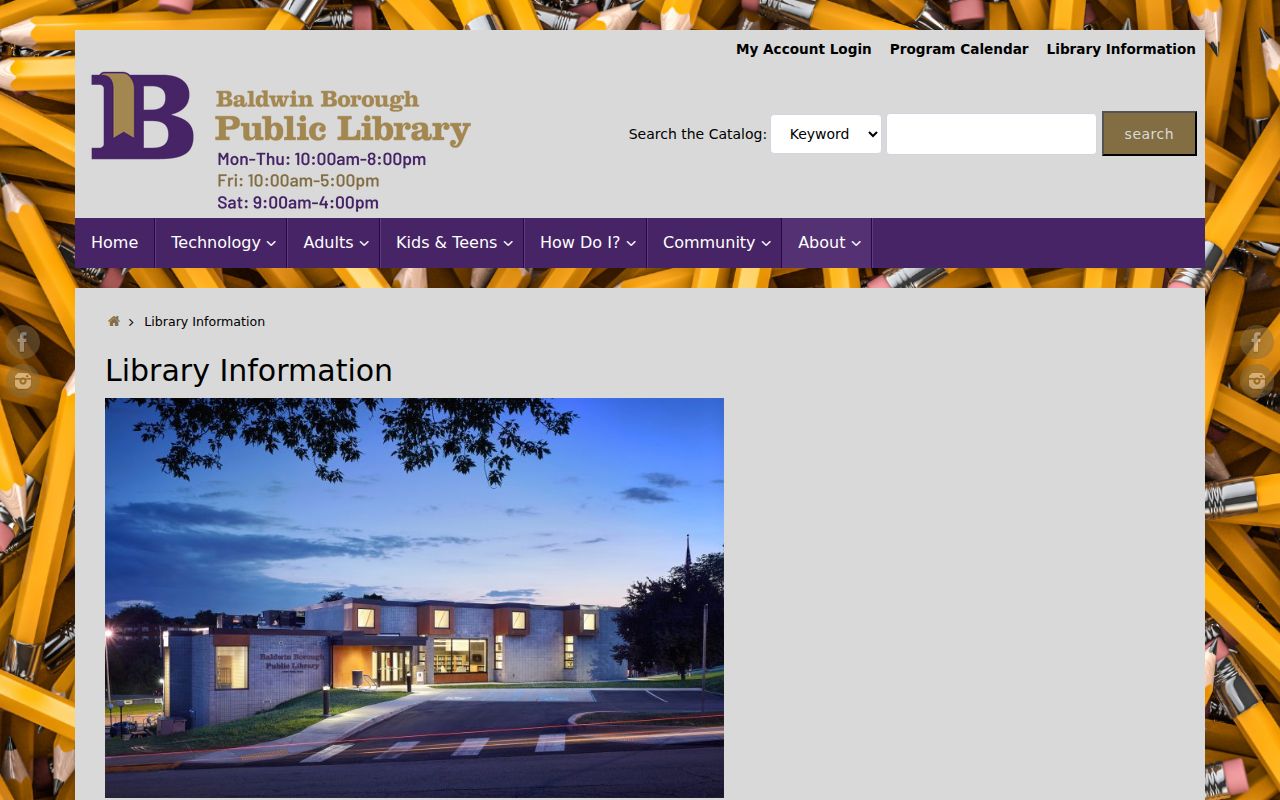
The library image supports the local contact route. It does not certify that a particular historical directory is on the shelf today.
For deeper regional work, the County’s libraries and societies directory points to Carnegie Main, Hillman, Darlington, University Archives Service Center, Historic Pittsburgh, Western Pennsylvania Genealogical Society, the History Center, and a Family History Center. These are distinct channels, not interchangeable claims of access. Carnegie offers regional research and microfilm; Pitt supports university collections; specialist groups may help locate holdings.
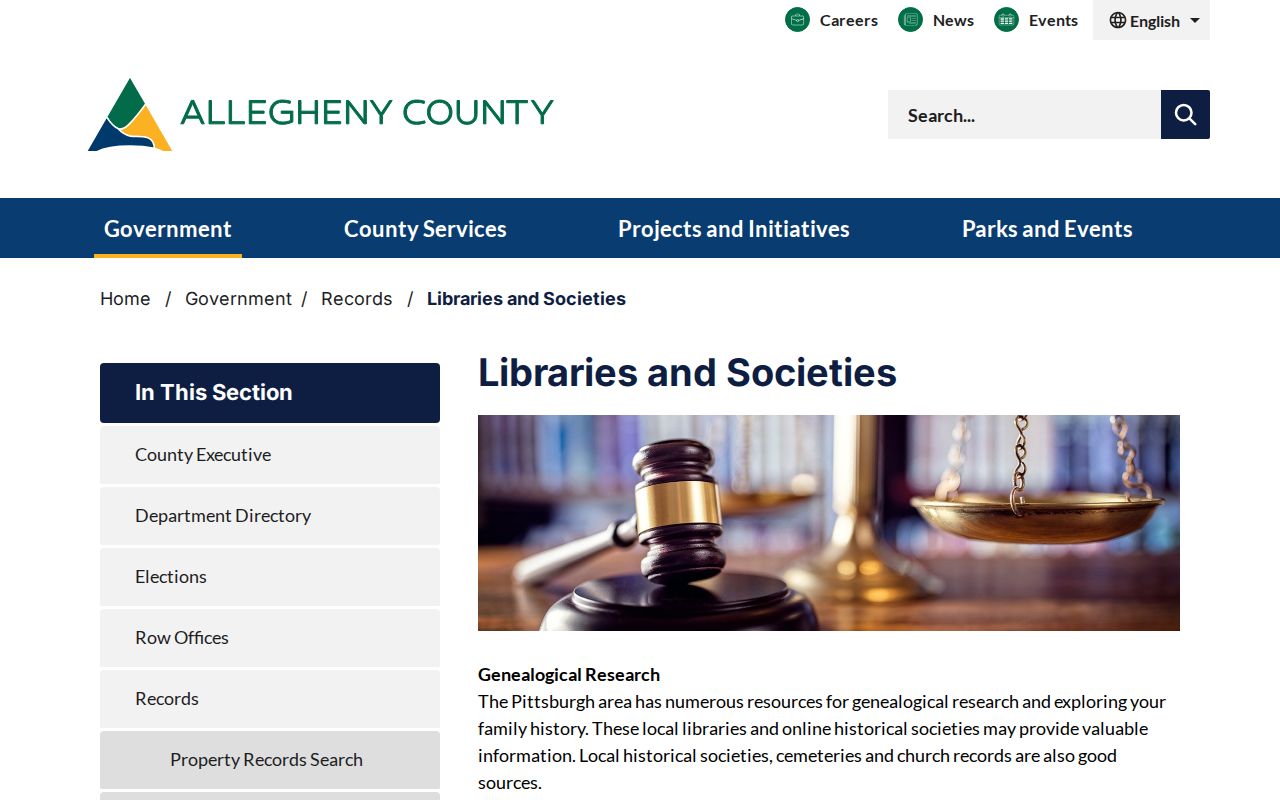
The county resource image helps route a request toward the right repository after the local library’s current shelf information has been checked.
Baldwin Directory Archive Alternatives
Detre Library & Archives is a regional fallback for maps, photographs, publications, organization histories, and archival collections. Its posted research hours are Wednesday through Saturday, 10 a.m. to 5 p.m.; research-only visits are free, appointments are recommended, and its listed telephone number is 412-454-6364. Its scale matters when a local directory does not answer the question: the archive reports large map, periodical, book, photograph, and archival holdings rather than one uniform local directory database.
The Heinz History Center’s additional resources page directs researchers to Historic Pittsburgh, Hopkins maps, the Warrantee Atlas, and Darlington digital maps. The Catholic Diocese of Pittsburgh offers a separate sacramental-record research path for records older than 70 years, beginning in 1808, with a posted research fee and at least a four-week request expectation. Neither route establishes a public parish roster or a directory entry.
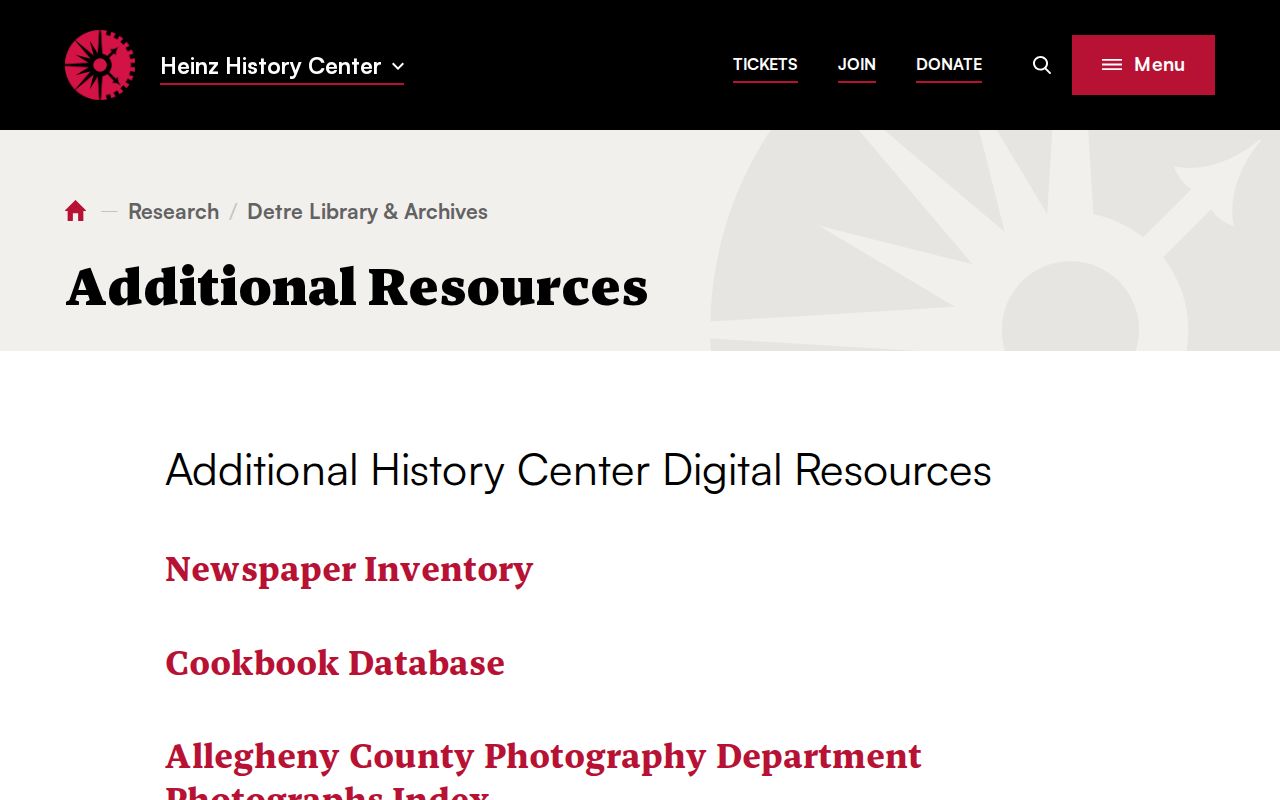
The archive resource image points to companion repositories when digitized directory pages or a local shelf cannot resolve the history.
Older Records Around Baldwin Directories
Allegheny’s historical record trail is broader than directory books. County guidance says deeds begin with county formation in 1789, estate records run from 1789 to date, and the Estates Index covers 1788–1971 at Carnegie Main’s PA Room. The Division of Real Estate also maintains a separate no-charge historical search for deeds, chattel mortgages, Feme Sol Trader offices, and related records from 1792–1857. Those uncommon offices can give a property or family trail more depth, but each record type has its own terminology and access context.
Use them as companion evidence, not as a substitute for a verified city directory page. A deed follows legal title; an estate file documents a court matter; a map fixes a dated spatial setting; and a directory may list a name or business at an address. Their answers can support one another without being collapsed into the same claim.
Note: No authoritative courthouse fire, flood, or other records-loss history was located for this research, so no destruction gap is assumed.
Missing Baldwin City Directory Entries
A missing search result can stem from geography, spelling, a volume’s coverage, the collection’s cataloging, a different street form, or a gap in a run. Start again with Baldwin Township for older material, retain the original street and lot clues, and look at adjacent South Hills localities only when the map supports the connection. Do not turn a regional book’s title into a guarantee of a Baldwin entry, and do not invent an unverified criss-cross run to fill an address gap.
For a house history, the next move is often the deed and parcel chain, then a Hopkins plate and identified directory year. For a family question, consider census, vital, probate, newspaper, cemetery, or church routes through the actual custodian or repository. Research uncertainty is useful information when it keeps a historical conclusion tied to the evidence that actually exists.