
Baldwin Previous Residents by Era
Previous residents are best traced on two parallel tracks. The property track follows the parcel, legal description, and recorded transfers. The household track uses identified directories, maps, census material, obituaries, estate files, newspapers, church or cemetery records, and other dated sources. They answer different questions. A deed changes title, while a directory or census may supply household context. Neither should be treated as a complete list of everyone who lived at the address.
| Source | Years It Covers | Where Held | What It Shows |
|---|---|---|---|
| Allegheny historic deed offices | 1792–1857 online segment | Division of Real Estate historic search | Historic deeds, chattel mortgages, and other historic offices |
| Recorder current document index | Indexes 1986–current; deed images 1976–current; mortgage images 1986–current | Division of Real Estate recorder system | Party, document, date, and instrument entry point |
| Historic Pittsburgh directories | Description: 1815–1945; visible filter: 1814–1963 | University of Pittsburgh Library System | Historical name, business, and address listings, after book-level coverage checks |
| Hopkins maps | 1896, 1905, 1916, and 1934 revised 1940 local anchors | Historic Pittsburgh | Streets, lots, owner labels, and historic place context |
| Allegheny local vital and estate aids | Births/deaths 1870–1905; Estates Index 1788–1971 | Carnegie PA Room and county or court sources | Event and probate leads, subject to source-specific access |
| Borough permit and transfer files | No public index or cutoff located | Baldwin counter and RTKL route | Dated local construction or transfer-administration evidence, where releasable |
The stated online ranges are not a finding that older material does not exist. They tell you when to move from a web result to historic offices, Room 101, record books, maps, library collections, or a focused municipal request.
Baldwin Address Records Start With a PIN
Begin an address trail in the free Allegheny County Real Estate Portal. Enter the house number where known, use the street name without its suffix, and select “Baldwin Boro” when the municipality is known. The free portal accepts address and parcel-number searching, while owner-name searching is a paid subscription function. A street-only result can paginate, so use a house number where possible and do not treat one result screen as a complete street inventory.
Record the parcel or PIN, situs address, municipality, displayed owner, sale or recording references, deed book and page, lot area, and the separate owner-mailing field. A PIN is the county parcel identifier. It ties the current parcel record to the legal property trail more securely than a street number alone. The site’s parcel address and owner-mailing address are different fields, and neither is evidence of current physical presence.
For a past-resident question, keep the searched address, returned situs form, municipality, ZIP, PIN, and date of access together. County Street Alias and Address Points layers, a period map, and the recorder’s legal description can resolve an older form without guessing that a similarly named street is the same property.
Trace Baldwin Deed Records Backward
The Allegheny County Division of Real Estate recorder search is the grantor-grantee tool for previous residents research. Its Deeds-office search accepts a business or last name, optional first name, party role, town, and filed-date range. Start with the current parcel’s sale or deed reference, then retrieve the acquisition instrument. The buyer or current owner is normally the grantee on that document, and the seller is the grantor. Search the seller as a grantee to locate an earlier acquisition, then repeat with the legal description and map-block-lot information in view.
- Open the current parcel record and capture the PIN, deed or sale reference, legal description lead, and recorded owner shown there.
- Search the associated name in the recorder’s Deeds office, using the recorded date range and spelling variants to control matches.
- Read the acquisition document or index entry, then identify the prior grantor and preserve the document number or book and page.
- Search that prior grantor as a grantee to find the earlier acquisition, comparing legal description, lot, block, and parcel clues at every link.
- When the online period or image path ends, ask the recorder counter for the appropriate book, map, card, microfilm, mail, or copy route.
- Grantor
- The party transferring an interest in the recorded instrument. In a sale, this is normally the seller.
- Grantee
- The party receiving an interest in the recorded instrument. In a sale, this is normally the buyer.
- Chain of title
- The sequence of recorded transfers tied to the same property. It shows title events, not every household member.
- Legal description
- The lot, block, plan, or other land description used in a record. It is often a steadier bridge than a changed street form.
Baldwin Historic Records, 1792–1857
Allegheny offers a separate, free historic deed and historic-office search for 1792–1857. The route includes historical deeds, chattel mortgages, Feme Sol Trader offices, and related records. It is not simply an earlier screen for the current recorder database. That separate coverage is important when a long property trail reaches the period before the modern system’s stated index and image ranges.
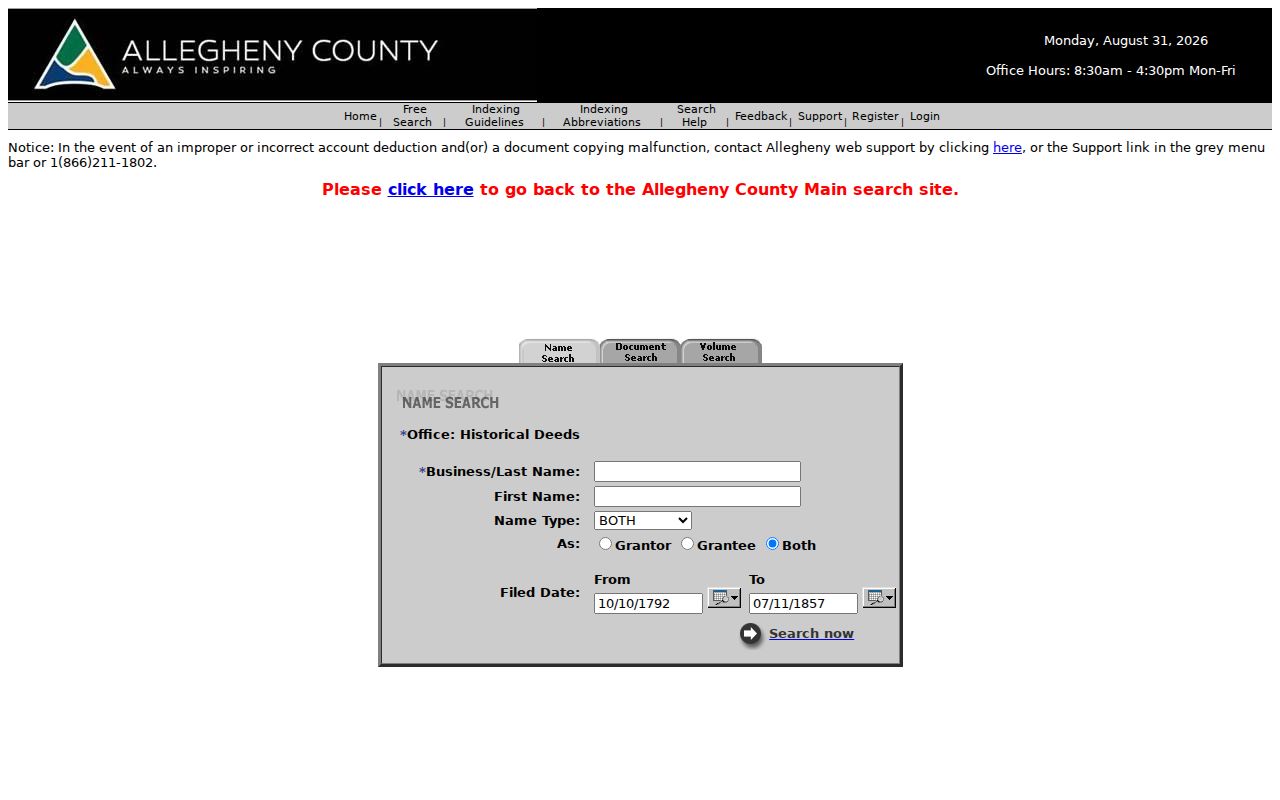
The historic-search image shows the specialized research route. It does not establish that an early record concerns the present borough or the same parcel without a legal-description and map check.
County guidance places Allegheny deeds from county formation in 1789 and records a historic-volume digitization project that began in 2017, but it does not prove a universal online image cutoff or completion for every historic volume. Treat the free historic search, books, and counter as complementary channels. The older geography may be Baldwin Township or another historic locality, so retain the place name printed on the record.
Baldwin Recorder Records and Images
The recorder homepage states that document indexes run from 1986 to current, imaged deeds from 1976 to current, imaged mortgages from 1986 to current, other documents from October 2001 to current, and subdivision material for all years. It also identifies historic block-and-lot maps, property-history cards before 1999, historic plats, and GIS updates. Those coverage statements are a starting point, not an all-or-nothing access rule. Search spelling variants and use the office, date, and party filters before concluding that an instrument is absent.
The recorder’s search page also directs researchers to free index searching and the division’s access options. The County Office Building counter is in Room 101, 542 Forbes Avenue, Pittsburgh, PA 15219; general questions go to 412-350-4636, option 2. Land-related copies are available online, in person, or by mailed request, and the county also identifies assessment, deed, mortgage, and historic-card copy channels.
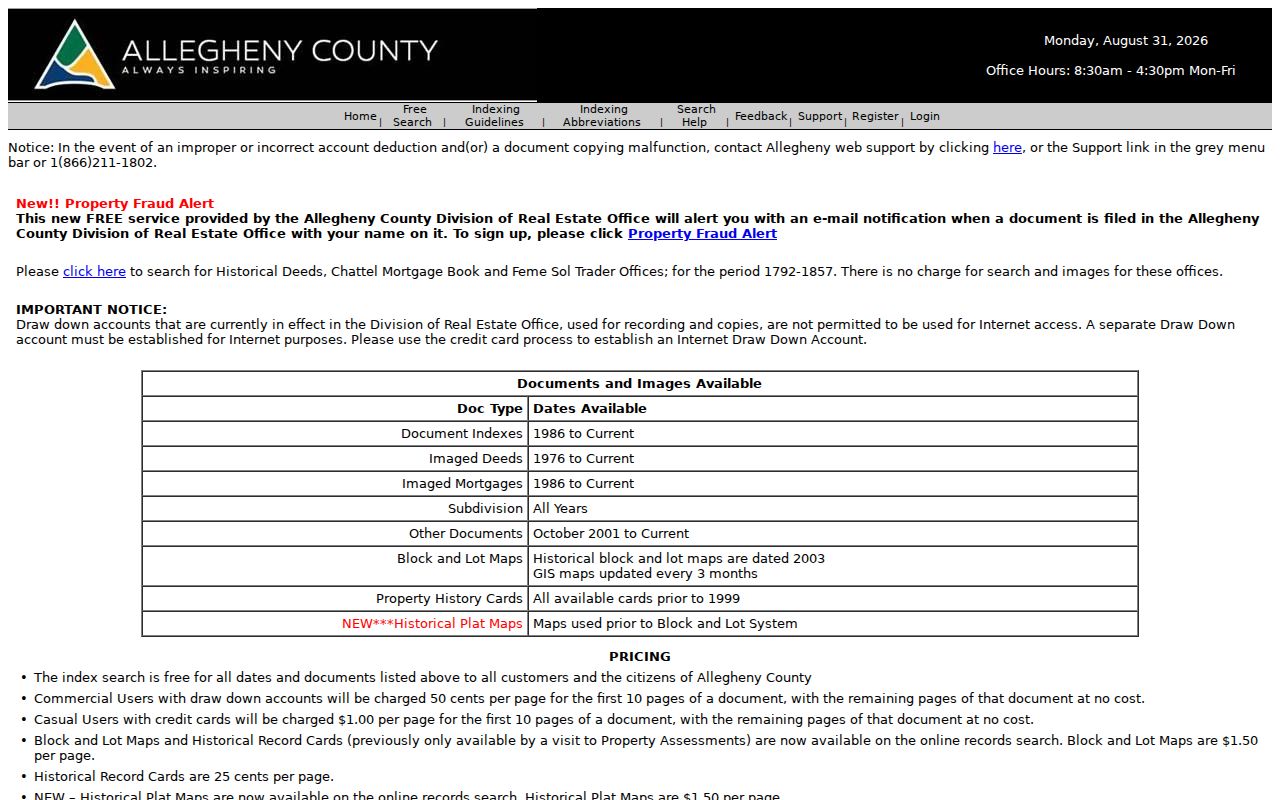
The recorder-index image supports the current-system entry point. A free index result is not the same thing as a document image or a complete property history.
Note: Keep the portal’s coverage statement with each missing-record note, then identify the next physical or request channel.
Baldwin Previous Addresses on Hopkins Plates
Historic Pittsburgh’s Hopkins map collection helps link a historical address to lot, block, street, and municipality context. The locally relevant anchors include southern-vicinity plates from 1896 and 1905, 1916 material for Baldwin and surrounding South Hills communities, and a 1934 Volume 9 revised in 1940. Map plates can display property-owner labels, but that is historical map evidence rather than a continuous title chain or a census of occupants.
The collection image marks a digitized route for date-specific books. Check every catalog item’s locality and page before connecting it to a Baldwin address.
The 1926 R. L. Polk Pittsburgh directory catalog record provides a verified five-volume publication to pair with a map when a matching address or locality is actually found. Historic Pittsburgh also lists Diffenbacher and other Polk volumes, but no confirmed reverse or criss-cross directory run for Baldwin was located. Do not treat an unverified directory format as an address index.
The Polk catalog image identifies a legitimate collection item, not a demonstrated Baldwin entry or a complete roster for an address.
Baldwin Township Changes Past Addresses
Baldwin Borough did not exist until January 1, 1952. Before then, a property may appear under Baldwin Township, a neighboring present municipality, or a Pittsburgh-related historic locality. The older township was much larger, touching or including land now in Baldwin, Whitehall, Brentwood, Castle Shannon, present Baldwin Township, Hays, Carrick, and Overbrook. This is a geography issue, not a documented borough-wide street renumbering event.
Baldwin’s borough-history source provides the incorporation date and an 1878 map of the former township. Use it with the County Street Alias and Address Points data and a period Hopkins plate. Retain the old and new place strings, postal label, and parcel clues in notes rather than forcing an old record into current borough geography.
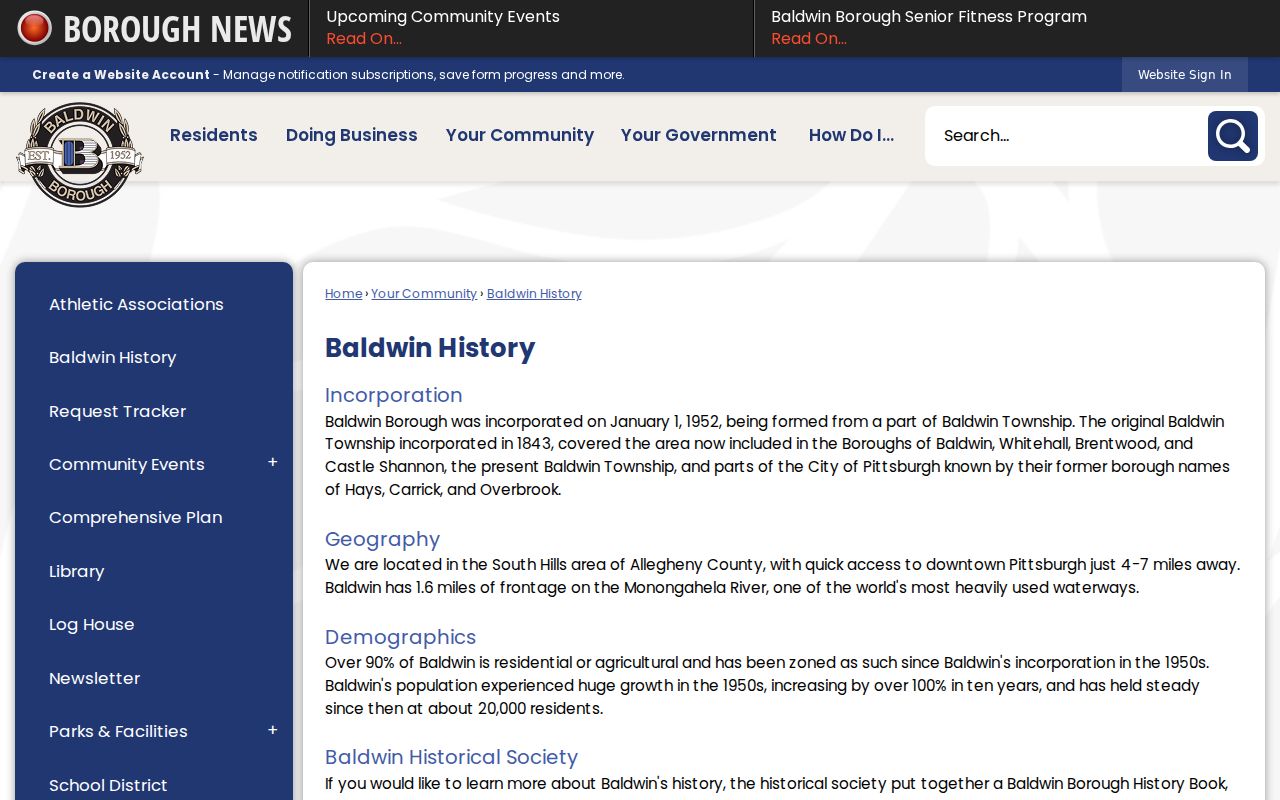
The borough-history image supports a boundary check before a past address is assigned to present Baldwin Borough.
Household Context Beyond Recorded Title
Previous residents requires a household track after the deed trail is built. The Baldwin city directory collections route covers the verified regional directory books and their coverage limits. Search a confirmed volume for name spelling variants, retain the printed address and locality, test the street on a same-period map, then compare a later or earlier identified directory with the relevant census period. A disappearance can mean a move, a death, a changed listing practice, or a coverage gap, so it needs another dated source.
Allegheny County’s genealogy gateway offers a broader route through deeds, maps, marriage, estates, naturalization, vital records, and census research. Carnegie Main’s PA Room is listed for federal census microfilm through 1920, Allegheny birth/death aids for 1870–1905, and the Estates Index for 1788–1971. Pre-1906 birth and death reporting was not mandatory, so a missing local index entry does not settle an event. Pennsylvania’s public historical vital windows are separate: birth records after 105 years and death records after 50 years are public under the Vital Statistics Law.
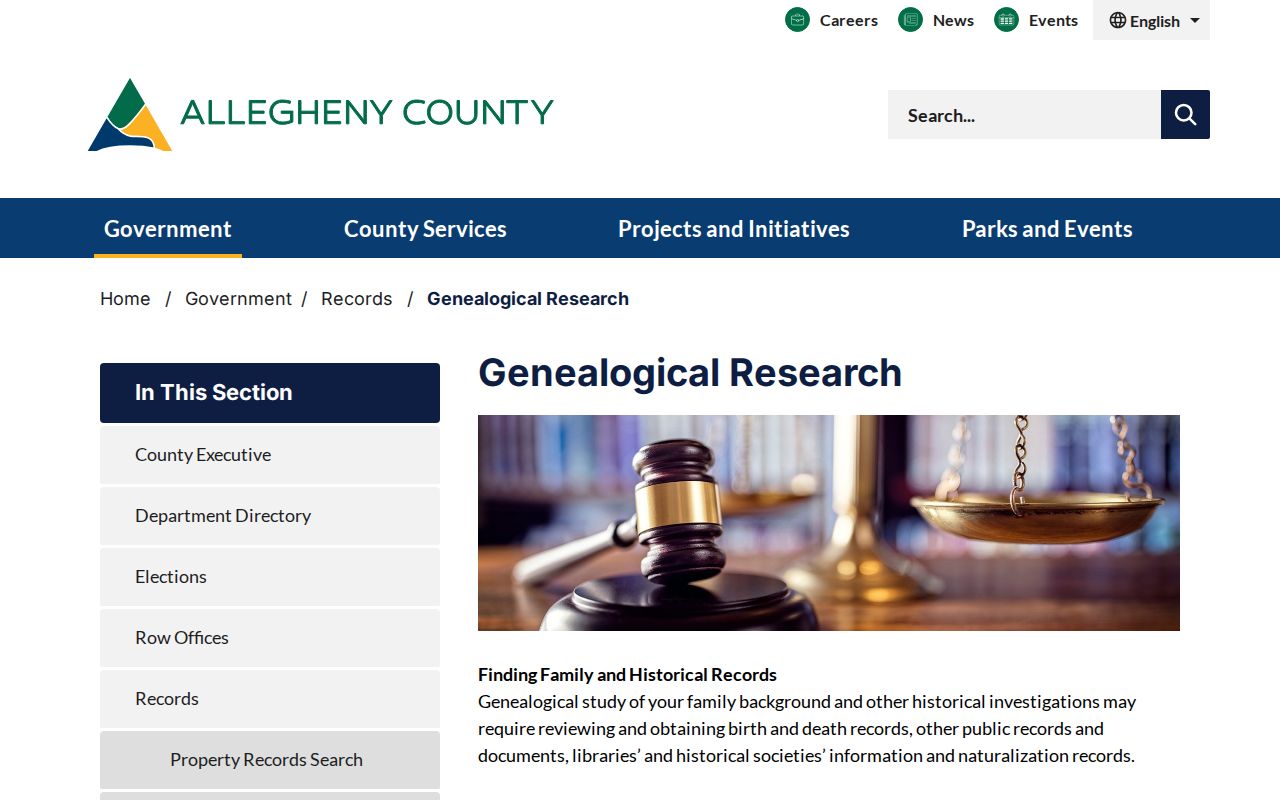
The county genealogy image points toward source-specific repositories after the legal-property chain and a verified historical address have been established.
Lawful use. Baldwin previous-resident research is for house history, family history, estate matters, and personal records questions. Pennsylvania harassment and stalking laws, 18 Pa.C.S. §§ 2709 and 2709.1, apply to threatening, harassing, or tracking conduct.
Baldwin Address Records Date Changes
The borough layer can add a later event to a property chronology. Baldwin Building Inspections and Code Enforcement handles construction, grading, property-maintenance, occupancy, and zoning subjects, but no public permit-search database was located. The building-permit form itself includes a site address, tax parcel number, lot or subdivision fields, owner and contractor details, project description, and date. It is a field guide to a released file, not a public list.
Baldwin’s property-transfer information identifies lien-letter, sewer-certificate, and occupancy procedures that can create dated local evidence. A narrow request should name the parcel or street address, record type, and time period. If the material is not posted, use Baldwin’s Right-to-Know route to reach the Open Records Officer. The Pennsylvania Right-to-Know Law provides an agency-record process, not a way around court, vital, or protected-address restrictions.
Keep each finding in its proper lane: a permit or occupancy file may date work or a local review, a deed may show a recorded transfer, and a directory or census may supply household context. A careful history leaves uncertainty visible instead of turning connected records into a claim the sources cannot support.